KISS OF THE SPIDER WOMAN | THREE MOVIES IN ONE & A CONVERSATION WITH BRUNO BICHIR

Kiss of the Spider Woman is an adaptation of the 1976 Argentinian novel by Manuel Puig, and Oscar winning film in 1985, returns as a musical movie directed by Bill Condon (Dreamgirls) starring Jeniffer Lopez with various roles, as Ingrid Luna, a movie star in Molina’s fantasies, and Aurora, a seductive femme fatale, the Spider Woman, a mythical figure whose kiss is lethal.

Kiss of the Spider Woman is a deeply political film set in military run- ‘80s era Argentina. The film centers on two prison cellmates Valentin Arregui (Diego Luna) a Marxist revolutionary and Luis Molina (Tonathiu), a gay window dresser imprisoned for corrupting minors.
Valentin and Molina survive the oppression and the grim colors of prison of misery and limited light and hope by narrating fantastic stories about Molina’s favorite musical actress, and dancer (Jennifer Lopez). However, the cellmates are at the mercy of the prison ward Oscar Ledesma (Bruno Bichir).
Kiss of the Spider Woman film also explores femininity in places where you would not normally expect it: in prison and through a man. The main plot is romance and what is more defiance in the face of heartless violence than love?
A CONVERSATION WITH BRUNO BICHIR
Bruno Bichir is one of the most talented actors working in current Mexican cinema, theater and television. He comes from a family of artists, as his parents and two brothers are also highly recognized actors and directors both in Mexico and the United States.
In Kiss of the Spider Woman musical, Bruno Bichir did not act as dancing and singing, but his character has the power to make others dance at his whim, however he is no stranger to dancing and musicals (Cabaret Mexico) as he has worked with some of the most important contemporary filmmakers.
We had the pleasure to talk to Bruno Bichir in México city on a Friday afternoon through zoom and here is his conversation with La Revista Mujer.
Hello Bruno, congratulations on your acting in the Kiss of the Spider Woman musical and thank you for granting us a few minutes for this interview. After seeing the movie I thought your character is so important because perhaps it is a key factor in the fate of cellmates Valentín Arregui and Luis Molina. What do you think? And why?
Well, thank you very much. And yes, I agree with you. Why? Precisely because we are living in a very turbulent world where it seems that we have learned nothing anywhere, and we keep making the same mistakes over and over again.
And there is the Nation of Argentina, flirting with a terrifying return to the darkest right wing. And the United States is going through very complex times in its domestic and foreign policies. Not to mention the world burning in flames. Why do I mention this? Because we really have three movies in one.
KISS OF THE SPIDER WOMAN: THREE MOVIES IN ONE
Can you tell us a little about this?
Well, one is this fantastic, beautiful, harmonious world. Even unreal, Hollywood-esque, golden and bright world.
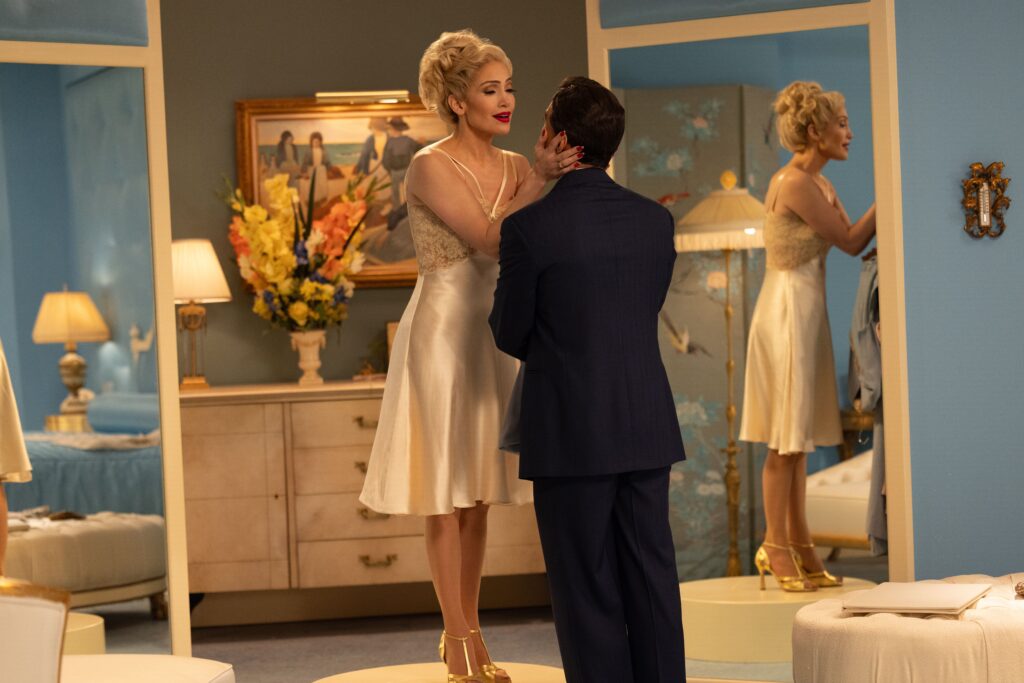
Second, through the imagination of this man who is debating between existing and not existing, because it seems unbelievable that at this point, he and many others like him are still debating between existing and not existing.
And they continue to be morally wrong and continue to be persecuted and singled out and continue to be at risk.
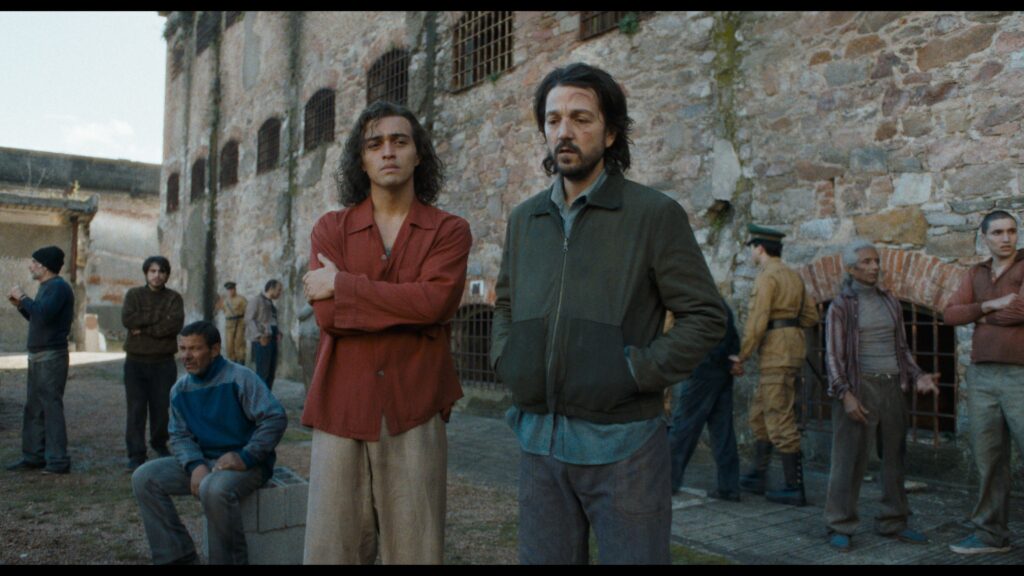
And third, what’s extraordinary is that this film was shot with a revolutionary who wants to change the world, utopically, as his counterpart, right?
These three points that form this triad come together to anchor it. That’s why I agree with you. My character is an anchor that brings us back.
What does your character as a prison ward represent?
A horrific awakening to reality. To the world outside, because ultimately the world of the cell becomes so claustrophobic and constricting that it ends up having an inner beauty in its photography, in its aesthetics.
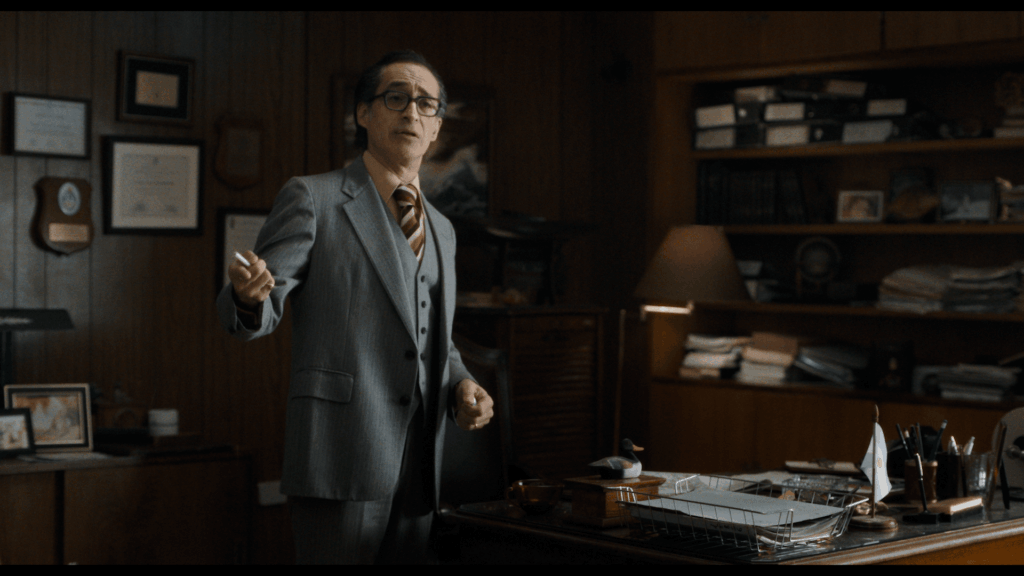
In its colors, it ends up being beautiful, but the world outside, which seems very free, is the one that is falling apart, and that is what my character represents: ambiguity, because this man could be a perfect, good family man and be this great bastard that he is.
And a bastard because he has no grace; he is a despicable, infamous being who plays with the emotions, the mind, the feelings, and the physicality of those he can control.
And at the same time, we don’t know if he really represents a tiny piece on the board or if he is someone who really dictates the paths of many lives.
And that’s what happens to us ordinary people, isn’t it? We just feel that horror above us, it’s indecipherable, we can’t understand it, and it mocks us every day, every hour, and it doesn’t sing and dance exactly, and it’s not pretty around.
And so that’s what I think is important about my character, he functions as an anchor on this ocean liner that is sailing through very turbulent waters.
The film plays on the simple contrast between the vitality of the fantasy film and the brutal reality of the prison and the political regime of the time, why is this contrast emphasized throughout the film?
Because otherwise what we’re seeing would be inconsequential and banal, even in the cell that comes back, right? But even the cell, because it’s a world that only happens there, right?
“But when you see the outside, that’s when you realize that any of us could be there. For whatever reason, and that you can fall into the claws of a system.”
Oh, look, I’m not in prison, I don’t know what that’s like, oh no, it’s horrible, well, poor things, those who are there.

What do you think is the relationship between art, whether fantastic or queer, and oppression?
It is precisely these great contrasts that we continue to experience throughout human history. Right?
This was experienced by Berlin in the 1930s, right at the height of the Nazi rise to power, as Berlin was the epicenter of freedom and expression, in all its forms.
And then a system endorsed by the people came along, which is the most frightening thing, and it ended up destroying all of that, even the horror, taking it to an indescribable horror, and now we are in the same situation, and it seems that we have learned nothing, and Argentina is going through those same turbulent waters and all of this.
It’s between fascinating and astonishing, astonishment that’s not necessarily happy, but astonishment nonetheless.
CONTRASTS
What happens even within our industry is that we just watched the Venice Film Festival as very glamorous, with big stars and everything being very beautiful. It’s a fairy tale, even the place itself is a fairy tale. Everybody was transported by boat, and the water and the divine sunsets and extraordinary languages and extraordinary clothes.
To celebrate a festival that doesn’t change the course of humanity, which is cinema, but nevertheless, a film that shows the horrors of humanity receives 15 minutes of standing ovation and everyone is crying and moved and saying that we are here celebrating banality—when there is horror, but everything is together.
That’s why I find this film so valuable, because it has those three points and everything is there so you can’t escape.
Even those who are distracted and just want to see Jennifer dancing like a goddess incarnate are going to get a big, profound, transcendent surprise when other themes are touched upon, as Manuel Puig does.
======================================================================

Kiss of the Spider Woman premiers in theaters on October 10th, be ready to go see it and not miss it as Bruno Bichir says, you are going for a big surprise. LRM

By Lilia Rodriguez – Davis
Editor in Chief of La Revista Mujer
Cover Photo by: Isabel del Villar
Photos Courtesy of: Roadside Attractions
Follow Bruno Bichir here
Follow Kiss of the Spider Woman Film here